|
Bharatanatyam:
|
|||||||||
|
||||||||||
Bharatanatyam
The Gods and the Goddesses, being dancers
Bharatanatyam used to be and is still mostly performed by
Bharatanatyam was largely restructured about 150 years ago by the Tanjore Quartet (Chinniah, Sivanandam,
Later, the prominent personalities as Mangudi Dorairaja Iyer and Krishna Iyer made their significant contributions. The social status and image of Bharatanatyam was finally restored
Bharatanatyam, although changed a lot, is still deeply rooted in Hinduism.
Most of the contemporary choreographers and dancers may use some of the formal Bharatanatyam technique or its elements to stage group performances presenting various themes such as nationalism, unity of religions, the sanctity of the environment, the animal rights activism, the greatness of a king or a political party, or even the delightfulness of Coca-Cola. In Vande Mataram, a dance festival organised under the auspices of Natyarangam, a project of Narada Gana Sabha in 1997 in Chennai, there was a host of topics: the caste and reservation systems, threat of nuclear weapons, evils of the current education system, bribery, religious fanaticism,AIDS, the population explosion, corruption in politics, secularism, the Dandi March, literacy, agriculture,the greed for riches, the Chinese aggression, mechanisation, industrialisation. Most recently, some dancers of Nrityanjali Academy (Andhra Pradesh) managed to draw their divine inspiration even from Condom Songs. The true Bharatanatyam is not
|
||||||||||
Bharatanatyam technique
"Bharatanatyam, in its highest moment, is the embodiment of music in a visual form", said Balasaraswathi. The sastra's stipulated that a dedicated dancer must be equally dedicated to music. In her demonstrations of Bharata natyam abroad, Balasaraswathi emphasised the connection between dance movement and raga (tune) expression in abhinaya (mime), with the subtle expressions of gamakas (voice modulations), intonations of sruti, and the development of improvisation in niraval" Sringara rasa (Love) was considered as the highest by the devadasis, as other emotion did not have the potential to convey the mysteries of the union of the human with the divine. Balasaraswathi's experience of dancing Bharatnatyam to many great devotional songs with no sringara lead her to realize that sringara is the fundamental emotion lending itself to infinite permutations of moods full of nuances and novelty. Sringara expresses the most intimate beauties of Bharatanatyam with all the purity of the spirit. Once considered to be an enemy of the spirit and the greatest obstacle to spiritual realization, the body itself is turned into a medium of the spiritual attainment. Bharatanatyam consists of three major aspects: Natya, Nritta and Nritya. Nritta is classified into Chari, Karana, Angahara and Mandala. Charis are 1-leg movements. Karanas are 2-leg
Bharatanatyam steps (adavus)
The body limbs are classified as Anga, Pratyanga or Upaanga. 6 Angas comprise: chest, waist, bottom, hands, head, legs. Some Bharatanatyam experts distinguish also neck.
Pratynaga
A standing posture is Mandala.
Bharatanatyam mudrasHastas or mudra's ( hand movements): Asamyuta, Samyuta, Hasta, Dashavatara, Navagraha, Jaati, Bandhu and Nritta Hasta. Bharatanatyam dancers who perfectly coordinate the main limbs with pratyangas and upaangas exhibit Angashudhi (clean lines). Lasya and Tandava In later tradition, Tandava came to mean the forceful and virile dance as performed by
Lasya, where the movements are soft, gentle, graceful and erotic, is performed by Parvathi. Many Bharata natyam scholars consider Lasya as the feminine version of Tandava. There are 2 styles of Lasya, Jarita and Yauvaka Lasya. |
||||||||||
Bharatanatyam: abhinaya
Bharata natyam techniques of
While gestures can be seen from any distance even in
The Abinaya can be of 4 kinds. Angikabhinaya deals with communicating the meaning of the songs by moving the limbs of the body.Vachikabhinaya is verbal story-telling.Aharyabhinaya includes the use of costumes, jewellry, make-up. Satvikabhinaya is the subtle and direct communication of moods (Bhavas) by a mental contact or glance. Lord Shiva is described in this stanza: We bow to Him, the benevolent One Whose limbs are the universe, Whose song and poetry are the essence of all language, Whose is clothed in the moon and the stars...
There are 8 main or primary emotions-relations-moods, Sthayi (basic) bhavas, which correspond to 8 Rasas: Shringara (Love),
These Bharathanatyam elements are also seen as the mystic symbols of Bhakti Yoga. Sringara means love, but this is not confined to rati sringara. There is bhakti sringara and vatsalya sringara besides rati sringara. Even among some of its practitioners, Bharatnatyam is often misinterpreted as being limited solely to bhakti. Balasaraswati believed Bharatanatyam is based on bhakti and that "it is justified in being called a yoga because it is a spiritual discipline perfecting the mind to thought-free serenity". The Nayika - Nayaka relationship
Nayika Bhava Abhisarika:
Bharatnatyam depicts different aspects of the Nayika
Sweeya refers to a woman that is married and faithful to her husband (necessities and duties of the material existence).
The Nayika shares her feelings with her companion, sends messages through her to the nayaka. The companion will settle down the quarrels between the nayika and the nayaka.
Nayaka Bhava The moods and emotions of the hero are represented by the main types. Dheerodaatta (such as Rama), Dheeroddhata (such as rakshasa Ravana), Dheeralalita (such as Vatsaraaja), Dheerashanta (such as Buddha). Bharatanatyam dancer pays attention to further aspects: Pati (married and faithful
Nayaka can be: Anukoola (faithful to one woman), Dakshina (loves all his women), Drishta (rejected, pleads to be accepted by his woman), Shatha (the deceitful one, such as Krishna). Nayaka's companion characters are: Peetamardhana, Vita, Cheta and Vidooshaka. |
||||||||||
Styles
|
||||||||||


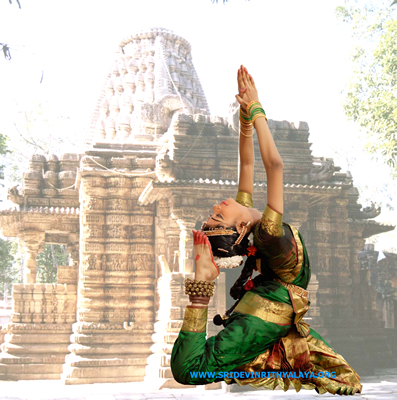


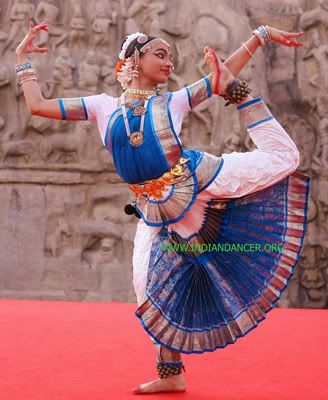
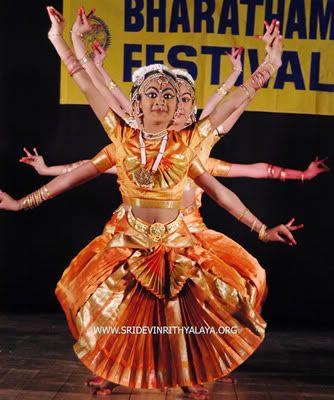

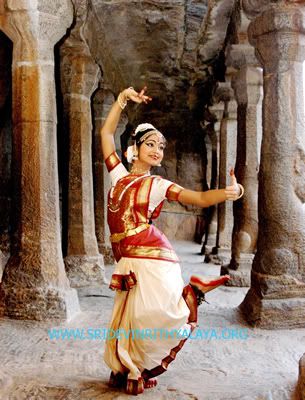 bharatanatyam |
|---|
The Pandanallur
style of Bharata-natyam stresses:
- its deep sitting positions
- predominantly Padartha abhinaya
- its lasya (feminine dance style) of padams is rather slow and difficult to perform
- it is performed on three levels: in deep sitting positions, on the ground, in standing positions and while moving or jumping.
The Vazhuvoor style of Bharata natyam includes:
- wide
range of dancing pace - static postures are inserted, most often
in the tillana, to break the monotony and to add the variety of rhythms - softer
facial abhinaya - abhinaya is subtle with more natyadharmi (spontaneous
expressions), so the presentation is not "overdone" - the
adavu's flow smoothly, with rare abrupt movements - extremely elaborate
movements - deep sitting positions
- variety of positions
on the floor - rich sringar elements
- lasya dominates
tandava - the dancer's body from the waist up is stlightly bent forward
- leaps are introduced into every jati
- the jati's have more korvais
(intervals), which creates a suspense effect - performance begins
with a Thodaya mangalam in honour of Lord Gnana Sabesar of Vazhuvoor - the
dancer starts the performance while entering the stage from the wings
The modern Kalakshetra style is a simplified form based on Pandanallur and, to some extent, Thanjavoor bani, as well as the European ballet. It is specifically suited for group performances, unlike other styles that are focussed on the solo. Kalakshetra's salient features are:
- minimal lasya and a virtual absence of recaka-s
- avoidance of the sringara-specific movements of the neck, torso, hips, etc.
- movements are angular, linear, clear-cut and sharp, with a larger amplitude than in the Pandanallur style
- predominantly Padartha abhinaya
- minimal nritya (e.g. as in the Pandanallur style, the dancer mostly walks around the stage and gesticulates rather than dances)
- stiff and controlled movements without akshepa (graceful throw of limbs)
- the themes are dedicated to modern social, economic and political issues
- easier to learn for western ballet dancers
The Balasaraswati style, although derived from the authentic devadasi traditions, was still a relatively recent introduction. Note that, most recently, Dr.Padma Subramaniam's school, claiming to be the one which is the most faithfully reflects the techniques described in Natya Shastra, is called Bharatanrityam .
 bharatanatyam |
|---|
Bharatanatyam dancers
Bharata natyam can be practised as a hobby or as a professional career. In the ancient scriptures, a professional Bharatnatyam danseuse
was called "patra". The AbhinayaDarpana's stanza on Patra
Prana Dasha Smrutaha (10 the ten essentials) of the professional dancer mentions these qualities:
- Javaha (agility),
- Sthirathvam (steadiness),
- Rekhacha
(graceful lines), - Bhramari(balance in pirouettes),
- Drishtir
(glance), - Shramaha (hard work),
- Medha
(intelligence), - Shraddha(devotion),
- Vacho (good
speech), and - Geetam (singing ability
Bharatanatyam dancer, according
to Abhinayadarpanam must be
 bharatanatyam |
|---|
- youthful,
- slender,
- beautiful,
- large-eyed,
- with
well-rounded breasts, - self-confident,
- witty,
- pleasing,
- capable
of keeping time (following the rhythm) - splendidly dressed
- of
a happy disposition.
More details are given by Natya shastra (XXVII.97-98).
Bharatanatyam dancers are considered inferior if they exhibit any of the 10 blemishes:
- white specks
in the apple of the eye - scanty hair
- thick lips
- pendant
breasts - too fat body or
- too thin,
- too tall or
- too short
- hunch-backed
- hoarse or voiceless.
 bharatanatyam |
|---|
Bharatanatyam recitals, items and arangetrams
Bharatanatyam performances are usually structured in either the Thanjor-Quartet format, margam (path), or a devadasi format. The graduation/debut performance is called Arangetram ("entering the stage").
Another name for it is Rangapravesha in Kannada. It used to be the first public appearance of the Bharatanatyam dancer, but now one can find even 5-year-old dancers performing "arangetrams". At an Arangetram the guru introduces his student to the public.
7-12 years of full-time training is necessary before the Bharatanatyam student is
ready for Arangetram.
Arangetram used to be referred to as Gejjepooje (worshiping the jingles) in the Mysore district. Bharata-natyam dancer considers jingles
as divine. Students did not wear jingles (salangai) till
their debut performance or till they consecrated the jingles at the Salangai Pooja that nowadays often precedes Arangetram.
Bharatanatyam dancer's orchestra most often consists of a vocalist, a mridangam (drum) player, a veena, a flute, a violin player and the
natuvanga (cymbals). Other instruments such as morsing are optional. Typically, the orchestra sit on the left side on the stage. The Bharatanatyam artiste wears a set of temple jewellery,
make-up and a tailor-made costume.
Bharatanatyam

bharatanatyam
Arangetrams can last up to 3 hours, and is a test of the dancer's stamina and concentration.
Bharata-natyam recitals usually are split into 2 parts. The first typically contains such items as Pushpanjali ,Kautuvam , Alaripu , Jatiswaram , Shabdam , Varnam . In the second the dancers often perform Padam ,Ashtapadi , Devaranama , Tillana ,Mangalam
Bharatanatyam dancers in Pushpanjali pay obeissance to the Devas (usually Nataraja or Vinayaka), the guru and the rasikas (spectators). This is a n opening, warm-up item.
Bharatanatyam dancers perform pure nritta in Alaripu. There are movements performed for rhythmic syllables (sollus). The movements gradually grow more and more complex, and the dancer concentrates deeper and deeper. The Bharatanatyam steps here resemble a bud opening into a full blossom. There is no verbal message communicated in this Bharatanatyam item that has no musical tune (raga).
Bharata-natyam artiste performs the movements in Jatiswaram, as these are devoid of any mental meaning or theme that can be verbally expressed.
The steps grow more complex than in the previous items. The choreography can include static postures, teermanas or muktayas (ending in a jathi). This Bharatanatyam composition is set to a raga (tune).
Bharatanatyam items of Shabdam include nritta and abinaya, and the themes of the lyrics
usually are devotional. The movements in these Bharatnatyam compositions may be either leisurely or vigorous. It the beginning, emotions
are subdued, then gradually released in a measured way.
 bharatanatyam |
|---|
Bharata natyam dancers perform Varnam next, where their abilities
to perform abinaya and nritta are tested throughout very complex steps, movements, and expressions that require stamina
and concentration. The lyrics in varnams are typically devotional, but can
also have shrigara rasa or other rasas as its theme.
Padams are the benchmarks of the Bharata-natyam dancer's abhinaya skills. It depicts the nuances of the divine love, pangs of seperation in love, etc., where the Nayaka-Nayika relationships are explored.
For example, the heroine can talk to her companion (as sakhi) and convey her feelings towards
her hero. The starting tempo is slow.
Bharatanatyam repertoire sometimes includes ashtapadi, based on Jayadeva's Geetagovinda. These are romantic compositions that describe Krishna's and Radha's love
in 12 cantos containing 24 songs. Each Canto is named according to Krishna's mood:
 bharatanatyam |
|---|
Saamodadamodara (Joyful), Aakleshakeshava (care-free), Mugdhamadhusoodhana (bewildered), Snigdhamadhusoodhana (tender and affectionate), Saakankshapundareekaksha (longing), Kuntavaikunta (indolent), Naagaranaaraayana (cunning), Vilakshalakshmeepatihi (bashful), Mandamukunda (languishing ), Chaturachaturbhuja (shrewd and wise), Saanandadamodara (blissful), Supreetapeetambara (ecstatic).
For the successful performance of these Bharatanatyam compositions, the dancer's grace and delicate facial expressions (mukha abhinaya) are paramount. The Bharatanatyam artists have to demonstrate their understanding of the lyrics , the situations, the interactions and
the rasas.
Bharatanatyam items occasionally include Devaranama, devotional pieces meant for a pure abhinaya, with hardly any nritta. These
Bharata natyam songs are usually the compositions of great mystics (Purandharadaasa,
Kanakadaasa, Vijayadaasa, Vyasaraaja, etc). Such compositions are popularly referred to as Daasa Sahitya, as they are written in plain language to be understood by everyone.
Bharatanatyam recitals often end in Thillanas, which are relatively new types of items, created in 20th century. Tillana s are full of nritta, with complex movements and postures,Muktayas or Sholkattu. This Bharatanatyam piece usually has a charana, a meaningful
piece of lyrics with an abinaya passage.
Bharatanatyam arangetrams or other programmes always end with Mangalams where the Bharata natyam
artists again thank god, guru and the audience for making the performance
a success.
In Tanjore Quartet's concept, a Bharatanatyam programme's format is meant to resemble the structure of
a Hindu temple: in alarippu the dancer passes through the gopuram (outer gate),
then in jatiswaram crosses the ardhamandapam (midway hall), in sabdam passes through the mandapam
(great hall of worship), and finally enters the heart of the temple in the varnam.
Bharathanatyam is an attempt to embody
the divine beauty, charm, rhythms and symbols that exist in heaven.
